




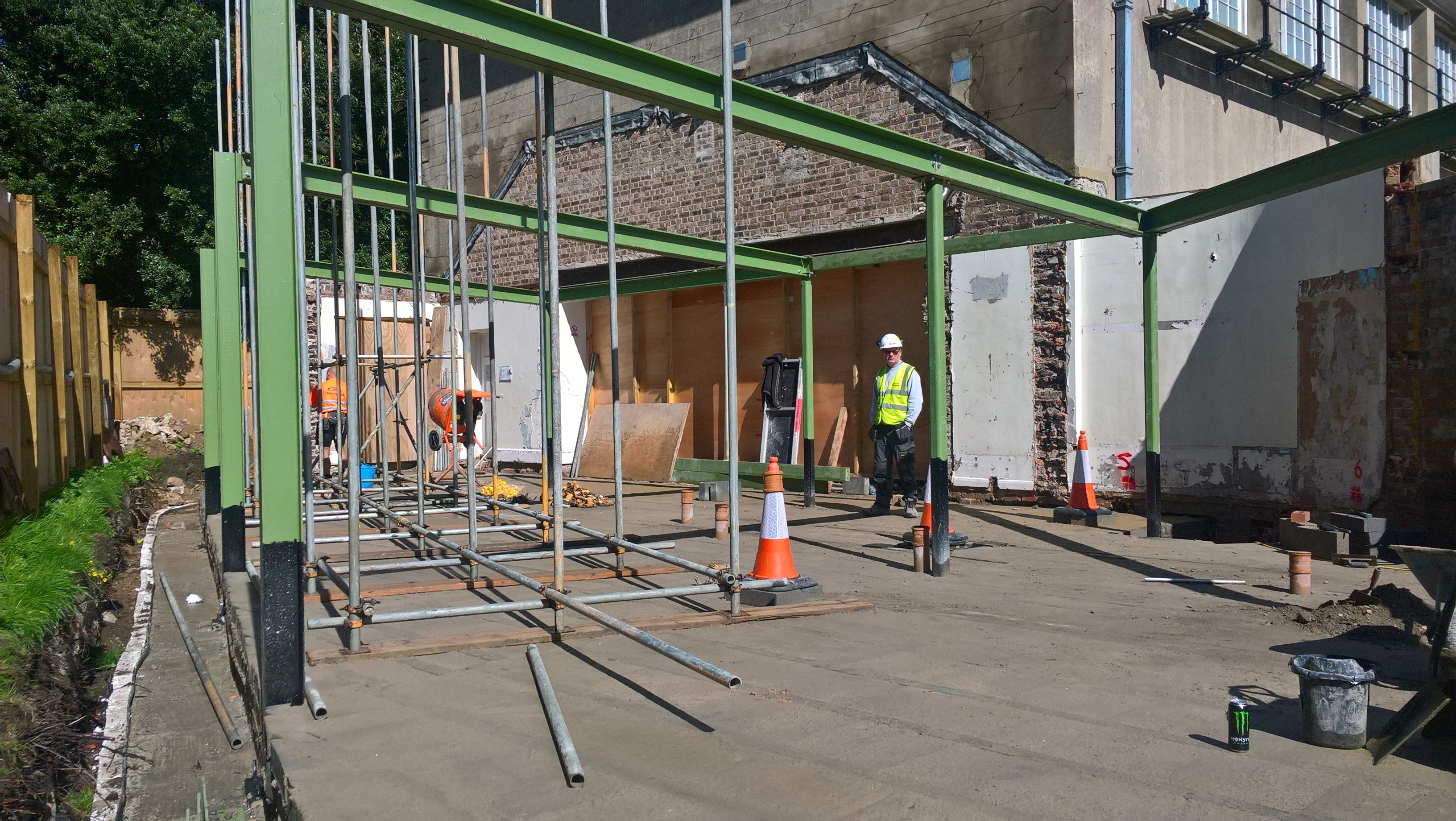
The extension is progressing well, with the roof structure due to start on Monday!
Home
PHTC visit the Gray’s factory in Cambridge
 On Wednesday 4th October Tom and Louis along with 6 PHTC members travelled up to Cambridge to have a tour of the Gray’s Factory. It was absolutely fascinating to see the 4 craftsmen at work. The rackets start with about 2 or 3 bits of wood, then go through some 60 odd processes to create the racket we love and use today. The PHTC group then headed over to the Cambridge club to play some doubles before watching Tom and Louis take on Cambridge in Division 1 of the National League. Louis beat Alex Evans 6/0, 6/4, Tom lost out to Ed kay 3/6 4/6 and they lost the doubles 8/5 with some very good tennis on show. A huge thank you to Martin and his team at Grays for showing us around and giving us an insight into how a real tennis racket is made. If you would be interested in doing a tour, do let us know and we will try and arrange a trip for you.
Hennell Plate Handicap Doubles weekend
Last weekend we had our first tournament of the new season and with handicaps ranging from the mid 30’s to the early 60’s there was some very entertaining tennis on show at the club.
This year we were slightly down on numbers due to the ongoing works at the club but never the less we still had sixteen pairs battling it out all weekend. Only one pair actually won all three of their group matches, so there were lots of very close games throughout the group stages.
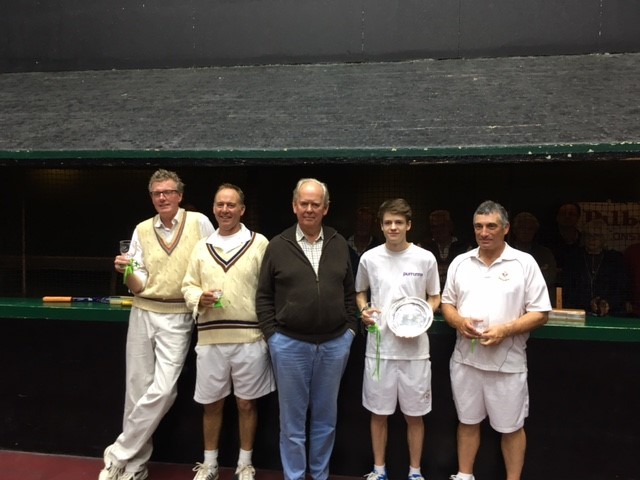 The first semi-final was between David Fortune & James Deuchar vs Will Rydon & Will Hextall. James and David stormed to a 5/2 lead only needing one more game to make the final but the two Wills played some very measured tennis taking the pace of the ball (which James was not so keen on!) to mount a huge comeback and take the set by 6 games to 5. In the other semi-final it was Ian Lambert & Monty Dix vs Mike Rogers & Julian Hill. The combination of power from Monty and Ian’s retrieving was too much for Mike and Julian, they won by 6 games to 2.
On to the final, Will and Will were having to give some 14 points away to Monty and Ian (owe 30, rec 15) and early on in the match it was very tight, at 4/2 there was a very close game which went to Monty and Ian and they then ran away to a 7/2 lead, but Will and Will won the next one and then got to forty all at 3/7 but couldn’t quite take it so Ian and Monty won by 8 games to 3 in a very nice final. Congratulations to Ian and Monty!
Thank you to Philip Robinson for presenting the prizes and to those members who very kindly supplied some biscuits and all those members that watched the final. We look forward to our next event which is the Robinson Trophy Scratch Doubles on the 28th and 29th October.
Latest photo of the Extension – Week 15
Obituary from the Times Newspaper of Basil Henson – Real tennis player and supporter
Basil Henson was not the worlds greatest exponent of real tennis, but he did have one faithful supporter. He would take his dog to sit in the dedans, an area behind the court where benches can be positioned. Every time Basil played a backhand volley, one of the more difficult shots, it would bark, said his friend John Farrall.
So enthused was Henson when he took up the esoteric sport in middle age that he played on most of the 40-plus courts throughout the world. Visits to the US, Australia, France and Lord’s were planned so as to partake in another match at another venue. He became a key administrator and, through the handicap system, continued competing until he reached 90.
Basil was a very charming man, comfortable with his own values, who raised funds for young people to participate, but self-denigrating on court and a dreadful player, Farrall said. I don’t know why he liked the game so much.
In his red Dunlop Flash tennis shoes, Henson cut a distinctive figure. He was a founder member of the Dedanists, a nomadic club named after the area frequented by his dog. The French appellation dates back to the origins of the game. The court resembles a medieval street or marketplace; its features — sloping roofs (penthouses), a buttress (or tambour), openings that serve the function of goals (the dedans, the grille and the winning gallery) — make the game a hybrid of squash and pinball.
The forerunner to lawn tennis, it was revived in the 1970s and 1980s. Real tennis is never going to grow enormously because of the costs of the courts, said Colin Dean, who plays at Hatfield House in Hertfordshire, where Henson became treasurer, chairman, vice-president and an honorary life member. Basil was nearly 50 when he started to play, but that did not matter because of the handicap system.
A further attraction for Henson, who was introduced to the game by a neighbour in Hatfield, was the lunch. His wife, Jill, was a businesswoman and a reluctant follower of the game, Dean said. But members wives were inveigled into providing lunches. There would be two games beforehand and three afterwards. And there might have been a bit of wine consumed as well. Henson’s other sporting love was cricket, and he would ensure real tennis at Lord’s and Melbourne was fitted around Test matches.
As well as Hatfield and Lord’s, Henson favoured Hampton Court, where Henry VIII oversaw the building of the Royal Court. Real tennis is not the only game to be described as “the sport of kings” but this truly was. Charles I and Charles II were devotees and would rise at 5am or 6am to play. William III took part fortified with stoups of Spanish wine.
Henson enjoyed appearing at Queens Club in west London when he was not at Lords, where he became a member of MCC. The amount of time he spent on the game had a bearing on where he lived: Hatfield and, after the death of his wife, a flat in Primrose Hill, close to the Home of Cricket.
Basil Howard Henson grew up in Brighton. His father, 68 when Basil was born, died virtually penniless seven years later. Henson spent more than three months in hospital with typhoid. Given a free place at Royal Russell School in Croydon, he undertook his National Service in the Fleet Air Arm before attending the London School of Economics.
His contemporaries included the future cabinet ministers Reg Prentice, who became a friend, and John Stonehouse, and his lecturers included Professor Harold Laski and Ralph Miliband. None of these left-wing figures (Prentice was to switch allegiances), however, significantly influenced his politics in that he was a staunch Conservative. Henson worked for the Commonwealth Relations Office, and was subsequently a banker for Chartered Bank of India, Australia and China, and worked for the Federation of British Industries and the City & Guilds of London Institute.
Henson’s wife, Jill Hine, whom he met at a party in 1966, had worked at Bletchley Park during the war. They married the next year and did not have any children. She accompanied him on a trip to France so that he could complete his full set of courts, although more were later opened. Henson’s final appearance on court was in a doubles match at Hatfield, two days after his 90th birthday.
Basil Henson, businessman and real tennis player, was born on May 28, 1925. He died on July 20, 2017, aged 92
Another Extension photo Update!
